



How is a sailor shirt made?
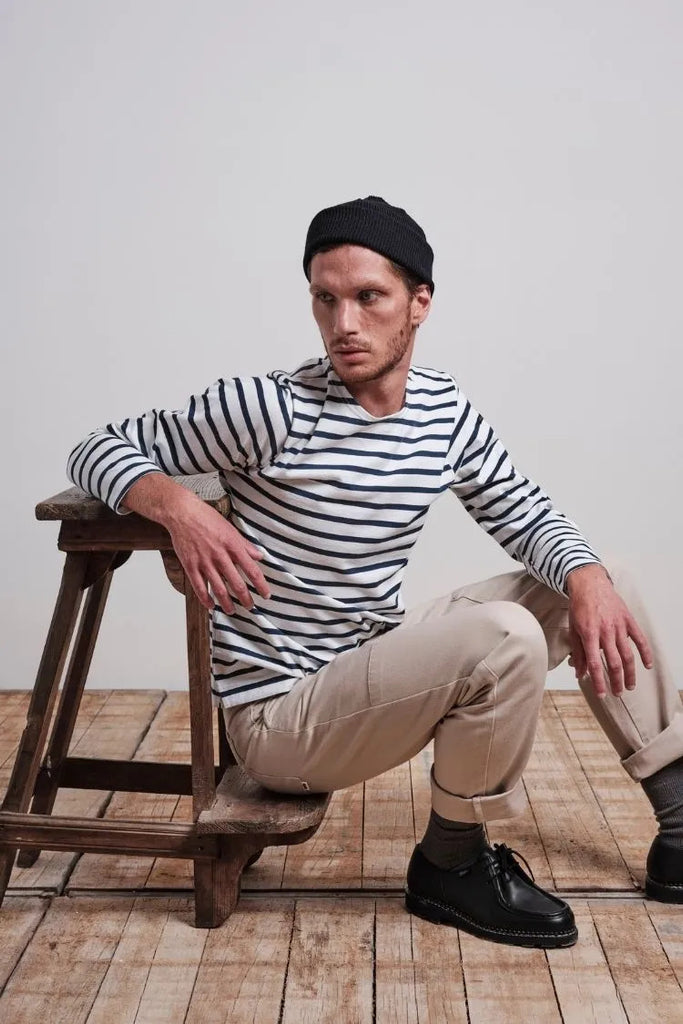
The term "marinière" historically referred to the sailor's jacket,
made of wool or linen, sometimes from an old sail.
Then, by metonymy, the word "marinière" came to designate the striped body knit,
placed just below the said vareuse.
Today, in ready-to-wear clothing, the word "marinière" is also sometimes used to designate striped sailor sweaters.
to designate striped sailor sweaters.
But in this article, we'd like to talk to you about this Breton cotton t-shirt we'd like to tell you about.
DISCOVER THE SECRETS OF MAKING A MARINIERE
The Breton shirt continues to be a symbol of French elegance the world over. This ancient undergarment has been a wardrobe staple ever since Coco Chanel decided to bring it back into the limelight in the 1920s.
Since then, its success has never been denied: marinières are timeless garments.
But, paradoxically, sailor shirts, a typically French garment, are still rarely made in France. At Le Minor, they are made entirely in Brittany, from cotton yarn that is itself made in France...
To find out all about how our French sailor shirts are made, watch our video mini-series here:
And if you prefer a little reading, we'll tell you all about it here:
CHOICE OF MATERIALS: ATYPICAL YARN, AUTHENTIC SAILOR SHIRT

Le Minor sailor shirts are special because they're still made "the old-fashioned way", with the "raw" cotton thread that is the hallmark of the traditional striped shirt.
This raw cotton thread was originally used to make ropes, not clothes. In English, it's known as "rope yarn". It retains a "dry", slightly wild look.
But why use raw cotton yarn?
To answer this question, we first need to understand that raw cotton is "carded" cotton. To put it simply, in cotton, there's combed cotton and carded cotton. Combed cotton is soft and carded cotton is softer. It's the spinning technique that produces this type of result: to obtain combed cotton, the spinning is longer and finer. The cotton fibers are then all "arranged" in the same direction, with nothing sticking out, and, as a result, the yarn is soft. Carded cotton has one less step. It's made up of less well-ordered cotton fibers, and as a result, it's less soft to the touch.
But the magic of carded cotton is its evolution: it will develop a patina over time, becoming a second skin. It elevates the garments it's made of to the rank of clothes you "make", like good old jeans or a sailor sweater. Clothes that stand up to anything, that become fetishes that we can't do without. Such is the case with the mythical Le Minor sailboat.
The other reason for using carded cotton in Le Minor striped shirt is that combing cotton is a skill that has been lost in France. Cotton is no longer combed in France, or very little. A cotton yarn spun in France will therefore necessarily be carded. And since the Le Minor brand's mission is to help maintain textile know-how in France, it's only natural that we've been using a French spinning mill for years.
Our cotton yarn is spun in the Vosges, at La Mouline, in Le Thillot. This is one of the last cotton mills in France.
THE FABRIC FOR OUR SAILOR SHIRT IS KNITTED, NOT WOVEN

The fabric used to make marinieres is knitted, not woven. The confusion between weaving and knitting is common, and can be found here and there, including among sailor shirts distributors, or in articles talking about fashion.
But it's really knitting. Most of the time, the fabric is jersey, which is indeed a knitted stitch, and even a simple set of stitches used as a basis for multiple developments.
The machines used to manufacture the fabric for marinières are circular knitting machines (or "looms"). Knitting takes place in a spiral, on large-diameter machines that turn on themselves in an almost perpetual motion. These knitting machines were developed to knit fabric continuously, by the kilometer.
These impressive machines, which are one of the highlights of the visit to Le Minor's workshops in Guidel, are the symbol of integrated manufacturing, which starts with fabric production. This model of a company, a manufacturing brand, in which a sailor shirt is produced from A to Z, even integrating fabric design, is unique in France.
On these machines, the fabric is most often striped, with continuous stripes ("all-over" as our Anglo-Saxon friends would say), or with "placed" designs, i.e. with stripes only on part of the fabric, and in fine, only on part of the body of a sailor shirt. These "placed" designs are a technical feat, requiring fine parameterization, and at Le Minor, on antique mechanical machines.
Bonnetier setting parameters on a mechanical circular knitting machine
FABRIC FINISHING: AN ESSENTIAL BUT LITTLE-KNOWN STAGE

Fabric ennoblement is certainly a stage in the manufacture of the sailor shirt that is largely ignored by the general public. Behind this very dignified term lies an essential step to ensure that the fabric of a marinière withstands domestic washing without a hitch.
It's also known as "calendering", "dyeing" or "stabilizing", because it's a bit of all of the above.
In short, it involves passing the roll of knitted fabric through several baths, and laying it flat - to counteract the spiral effect of knitting - to "shrink" the cotton, and make it stable.
This process requires immense machinery and technical know-how that we don't have at Le Minor in our workshop in Brittany. As a result, this is the only step in the production of the sailor shirt that is not carried out in-house.
We subcontract this stage to a partner workshop, Teinture et Apprêts Danjoux, in Roanne. Along with Troyes, Roanne is one of the old glories of French knitwear, where there are still some very fine industries involved in all stages of knitwear transformation.
CUTTING THE FABRIC: A DELICATE STAGE

The fabric-cutting stage is undoubtedly the key to the perfect finish of Le Minor marinières. A visit to the workshop may surprise you with the very artisanal dimension of textile cutting at Le Minor: in the cotton jersey cutting workshop, there are still very few mechanized stages, and the handling is cautious and necessarily human.
The moment of cutting is crucial: we have to get to grips with this naturally elastic material, cotton jersey, while ensuring that the pattern will be respected, and that the stripes (when the fabric is striped - which is most of the time!) can be matched at the moment of assembly.
When it comes to cutting the cotton fabric, we're somewhere between know-how and industry:
Know-how because these are manual steps. It's all done by hand, in pairs, as the rolls are cut to different heights, the different layers of fabric are quilted, the fabric is cut to shape, and the alignment of the stripes is readjusted between each of these stages.
Industry, because each sailor shirt is mass-produced to meet minimum quantity and production rate requirements.
Cutting the striped jersey for Le Minor marinières
ASSEMBLING A SAILOR SHIRT: SEWING AND KNOW-HOW

The sewing of a sailor shirt, as such, is the stage that consists in assembling the different pieces of fabric previously cut, to give the garment its final shape.
It's the most transparent step in making a sailor shirt for everyone, because we've all been in contact with a sewing machine. The image of the sewing workshop is the first image that comes to our customers' minds when we tell them "we are a manufacturing brand". Of course, that's not all. At this stage of the article, as you'll have gathered, it's important not to overlook the steps involved in sewing a sailor shirt. Steps we've been keen to highlight, to give them back their letters of nobility: knitting, fabric stabilization and cutting.
The stakes involved in sewing a marinière are quite simple:
- Sturdiness: Le Minor garments derive their reputation from their unfailing quality. And our promise is that you'll buy a marinière that will last more than 20 years, and a sweater that will last more than 40 years. Double-needle stitching and the choice of sewing thread all play their part in this objective of producing sturdy marinières.
- The quality of the finish: hems, slits, regularity of seams - all these external aspects are essential for a carefully crafted marinière. But the cleanliness of the seams and the absence of protruding threads... inside the garment, are also evaluation criteria for the cleanliness of the finishes.
- Stripe matching, finally. Stripes must be perfectly matched when assembling a cotton marinière. This art, which is a pure diktat of fashion (do you think 18th-century sailors cared about having the sides of their underwear nicely worked?) plays a big part in the know-how of our seamstresses, who specialize in making marinières. Matching stripes is all the more complicated as this step is carried out when only one of the 2 sides to be joined is visible! And the drive of a sewing machine means that the underside moves faster than the upper side: you therefore need to perfectly control the progress of your work under the presser foot of the serger to succeed in this step. Art, we tell you!
We couldn't end this paragraph on the making of sailor shirts without mentioning the great upheaval that took place in French textile workshops. To cut a long story short - and "upheaval" is a poor way of describing the destruction of an entire sector of the textile industry in France - we had to switch from a highly Taylorized manufacturing process to a much more flexible one. In the new organization of French textile workshops, notably at Le Minor, a specialist in the manufacture of 100% made-in-France cotton marinières, each operator can be involved in every stage of production: quilting, overlocking, hemming, trimming, buttoning, etc., and is no longer specialized in a single operation.
This versatility streamlines production.
QUALITY CONTROL AND FINISHING: THE FINAL STEPS IN THE MAKING OF A MARINIERE

"Le Minor" has always rhymed with "very high quality". This quality has been reinforced over the years by contact with very demanding customers. These include the French Navy, with its in-house quality control inspections, and the Japanese: absolute fans of the Le Minor brand, they are also extremely vigilant about the quality of fabric, stitching and finishing.
In response, Le Minor has developed a quality control system for its marinières, during which each of the above manufacturing stages is scrutinized: regularity of jersey knitting and absence of pollution in the fabric, appropriateness of the cut of the striped fabric, perfection of the regularity of the various stitches. Everything is scrutinized for perfection!
And to put the finishing touches to the Le Minor marinières, Solange, a 46-year veteran of the company, irons each of the sailor knits individually, sifting through them with her Lynx eye.


